

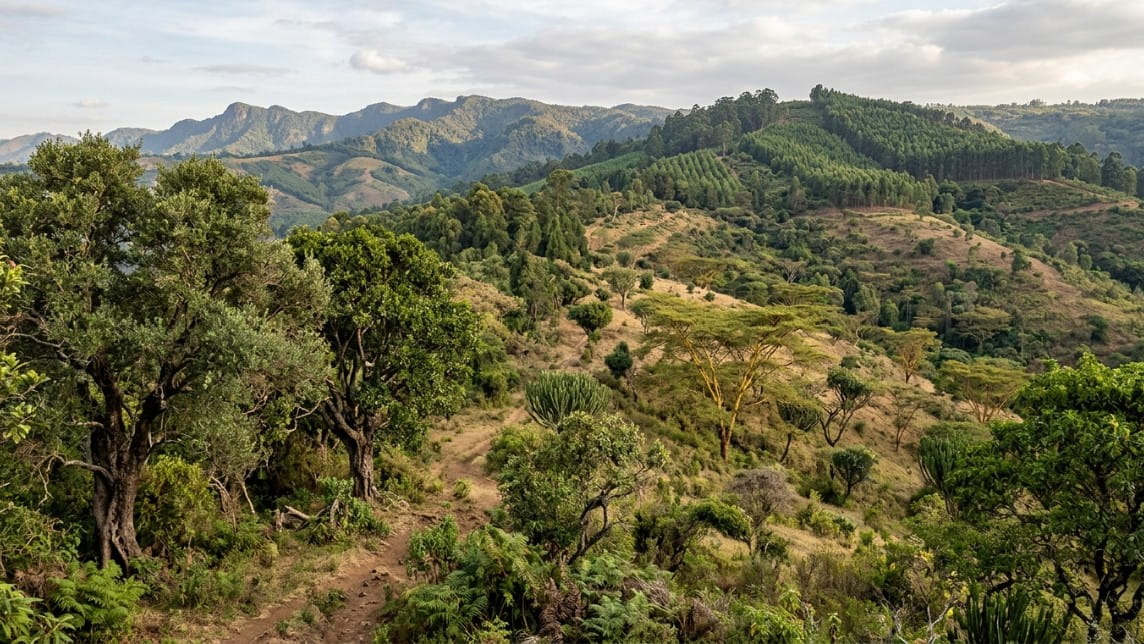
Kenya has a wide range of tree species. They grow in forests, farms, towns, rangelands, river valleys, mountains and coastal ecosystems.
Some are indigenous trees that occur naturally in Kenya. Others are exotic trees introduced from other parts of the world and now widely planted for timber, fuel, shade, food, construction and other uses.
Knowing the difference between these trees helps with tree planting, forest management, conservation and land-use planning.
This guide introduces the main groups of trees found in Kenya, their uses, how to identify them and where they grow. It also links to detailed species guides covering individual Kenyan trees.
1. How Many Tree Species Are Found in Kenya?
There isn’t one simple number that represents all tree species found in Kenya.
Kenya’s trees occur across many ecological zones, from humid forests and highland areas to drylands and the coast. Some species are widespread, while others have very limited natural ranges.
The number also depends on what is being counted. A list may include native tree species, introduced species, cultivated trees, naturalised species or trees found only within particular habitats.
This is why a useful guide to Trees in Kenya should focus on species groups, ecological zones, uses and identification rather than presenting one fixed number as the total.
Kenya’s botanical resources include a large range of indigenous species. The country’s forestry institutions also continue to research, conserve and promote tree species for restoration, agroforestry and commercial forestry. The State Department for Forestry works with institutions including the Kenya Forest Service and Kenya Forestry Research Institute on these areas.
2. Indigenous Trees in Kenya
Indigenous trees are species that occur naturally in Kenya or in the wider region where they evolved.
They form part of Kenya’s natural ecosystems. Some occur in forests, while others are found in dry woodlands, coastal forests, riverine areas, mountains and other habitats.
Examples of indigenous trees found in Kenya include:
- Acacia species
- Afzelia quanzensis
- Albizia species
- Croton megalocarpus
- Ficus species
- Juniperus procera
- Melia volkensii
- Prunus africana
- Podocarpus species
- Vitex keniensis
- Warburgia ugandensis
This is only a small selection. Kenya has many other indigenous tree species with different ecological ranges and uses.
2a. Why Are Indigenous Trees Important?
Indigenous trees have developed under local environmental conditions.
Depending on the species, they may provide:
- Wildlife habitat
- Food for people and animals
- Timber
- Fuelwood
- Medicine
- Shade
- Soil protection
- Carbon storage
- Pollinator resources
- Cultural resources
Some indigenous trees are also important because they are restricted to particular ecological regions.
For restoration work, the choice of indigenous species should consider the original vegetation, local climate, soil and the purpose of restoration.
3. Exotic Trees in Kenya
Exotic trees are species introduced outside their natural geographic range.
Some exotic trees have become important in Kenyan forestry and agriculture because they grow well under suitable local conditions.
Common examples include:
- Eucalyptus species
- Cupressus lusitanica (Mexican cypress)
- Pinus patula
- Pinus radiata
- Grevillea robusta (silky oak)
- Casuarina equisetifolia
Some are grown mainly for timber. Others are planted on farms, around homes, along roads or in agroforestry systems.
Kenya’s national forest data identifies Cupressus lusitanica, Eucalyptus species and several pine species among important exotic plantation species. It also records Grevillea robusta as an important agroforestry tree.
3a. Are Exotic Trees Bad for Kenya?
Not automatically.
The effect of an exotic tree depends on the species, location, planting density, management and surrounding ecosystem.
Some introduced species are important sources of timber, poles, fuelwood and farm income. Others can become invasive or create ecological problems when planted in unsuitable environments.
The right question is therefore not simply whether a tree is exotic. It is whether the species is suitable for the site and the intended purpose, and whether it is being managed responsibly.
4. Indigenous vs Exotic Trees
The difference is mainly about natural geographic origin.
| Feature | Indigenous trees | Exotic trees |
|---|---|---|
| Natural origin | Occur naturally in Kenya or the region | Introduced from another region |
| Adaptation | Evolved under local or regional conditions | Adaptation varies by species and site |
| Biodiversity value | Often important to native ecosystems | Depends on species and management |
| Common uses | Timber, food, medicine, wildlife habitat and conservation | Timber, poles, fuelwood, agroforestry and other uses |
| Examples | Vitex keniensis, Warburgia ugandensis, Melia volkensii | Eucalyptus, Cupressus lusitanica, Pinus |
The distinction doesn’t mean that every indigenous tree is suitable for every location or that every exotic tree is unsuitable.
Tree selection should always consider the site and the purpose of planting.
5. Common Tree Groups Found in Kenya
Kenyan trees can also be grouped by their botanical families and growth characteristics.
Some important groups include:
5a. Acacia and Related Trees
Many trees traditionally called acacias are found in Kenya’s drylands and savannas.
They are often adapted to drought and provide browse, shade, fuelwood, habitat and other resources.
The taxonomy of African acacias has changed over time, so scientific names should be checked against current botanical databases when preparing species-level information.
5b. Fig Trees
Ficus species are important trees in many Kenyan ecosystems.
They can become large trees and produce fruits that provide food for birds, mammals and other wildlife.
Some fig species also have strong cultural significance in Kenya.
5c. Podocarps
Podocarpus species are associated mainly with Kenya’s wetter highland and montane environments.
They are important components of some indigenous forests and can reach large sizes.
5d. Cedar
The East African cedar, Juniperus procera, is one of Kenya’s important indigenous coniferous trees.
It occurs mainly in highland and mountain environments.
Its timber has long been valued, although natural populations have also faced pressure from harvesting and land-use change.
5e. Eucalyptus
Eucalyptus is one of the most widely planted exotic tree groups in Kenya.
Different species are grown for timber, poles, fuelwood and other purposes.
They are common in farm forestry and commercial plantations, especially in suitable highland areas. Kenya’s national forest data identifies eucalyptus as a major plantation group.
5f. Cypress
Cupressus lusitanica is widely planted in Kenya’s highlands.
It is mainly associated with timber production and plantation forestry.
The species is also important in farm forestry and has been planted extensively in areas with suitable rainfall and elevation.
5g. Pines
Several pine species are grown in Kenya.
Pinus patula is particularly associated with montane plantation areas, while other pine species have been planted in different ecological zones.
Pines are mainly valued for timber and other wood products.
6. Trees by Kenyan Ecological Zone
Where a tree grows is one of the most useful clues when identifying it.
Kenya has several major ecological zones, and different tree species are adapted to different conditions.
6a. Highland Trees
Kenya’s highlands support many indigenous and planted tree species.
Common examples include:
- Juniperus procera
- Podocarpus species
- Prunus africana
- Croton megalocarpus
- Cupressus lusitanica
- Pinus patula
- Eucalyptus species
- Grevillea robusta
The exact species present depends on altitude, rainfall, soil and land use.
6b. Dryland Trees
Dry areas require trees with adaptations to water stress.
Important examples include:
- Melia volkensii
- Acacia species
- Commiphora species
- Balanites aegyptiaca
- Boscia species
- Adansonia digitata
Some dryland trees provide valuable fruits, fodder, timber, medicine, gums, resins and fuelwood.
Melia volkensii, for example, is an important dryland agroforestry tree in Kenya.
6c. Western Kenya Trees
The wetter western region supports a different group of tree species.
These include indigenous forest species as well as trees commonly planted on farms.
Examples include:
- Croton megalocarpus
- Markhamia lutea
- Prunus africana
- Grevillea robusta
- Eucalyptus species
Western Kenya also contains important rainforest ecosystems such as Kakamega Forest.
6d. Coastal Trees
Kenya’s coastal region supports tree species adapted to warm temperatures, coastal soils and seasonal rainfall.
Examples include:
- Afzelia quanzensis
- Casuarina equisetifolia
- Tamarindus indica
- Adansonia digitata
- Milicia excelsa
- Terminalia species
The coast also contains mangrove species that are adapted to saline and tidal conditions.
6e. Riverine Trees
Riverine habitats support tree species that depend on access to water.
Examples include species of Acacia, Ficus, Tamarindus and other trees adapted to river valleys and floodplains.
The species mix varies between rivers and ecological regions.
7. Trees in Kenya by Their Main Uses
Kenyan trees have many uses.
The same species can provide several products or services, depending on how it is grown and managed.
7a. Timber Trees
Some trees are grown mainly for timber.
Important examples include:
- Eucalyptus species
- Cupressus lusitanica
- Pinus patula
- Pinus radiata
- Grevillea robusta
- Melia volkensii
- Vitex keniensis
Timber quality varies by species, age, growing conditions and how the tree is processed.
7b. Fruit Trees
Trees provide both commercial and subsistence fruits.
Examples include:
- Mango
- Avocado
- Tamarind
- Baobab
- Jackfruit
- Loquat
- Guava
Some fruit trees are indigenous, while others were introduced and are now widely cultivated in Kenya.
7c. Fuelwood Trees
Many rural households depend on wood energy.
Species used for fuelwood vary by region and availability. Farmers may use branches, prunings, small stems or trees grown specifically for wood energy.
Fast-growing species such as some eucalyptus trees are widely used for wood products and fuel, although management should match local site conditions.
7d. Fodder Trees
Some trees provide leaves, pods or other material that livestock can eat.
This is especially important in dryland and pastoral areas.
Examples include some Acacia, Albizia, Leucaena and Calliandra species.
7e. Medicinal Trees
Many Kenyan communities have long traditions of using tree bark, roots, leaves, fruits or other plant parts in traditional medicine.
Examples include:
- Warburgia ugandensis
- Prunus africana
- Kigelia africana
- Azadirachta indica
Traditional use should not be treated as proof that a plant product is medically effective or safe. Some plant compounds can also be toxic or interact with medicines.
7f. Shade and Ornamental Trees
Trees are widely planted around homes, schools, roads, institutions and towns.
They can provide shade, improve the local environment and contribute to urban green spaces.
Species selection should consider mature size, root growth, water needs, branches and proximity to buildings or power lines.
8. How to Identify Trees in Kenya
Tree identification should use several features rather than one characteristic.
A tree may look different depending on its age, season, growing conditions and whether it is flowering or fruiting.
Useful identification features include:
8a. Leaves
Look at:
- Leaf shape
- Leaf size
- Leaf arrangement
- Leaf margin
- Leaf texture
- Number of leaflets
- Vein patterns
- Whether leaves are simple or compound
Leaves are often the easiest feature to examine, but they shouldn’t be used alone.
8b. Bark
Bark can provide important clues.
Look at its:
- Colour
- Texture
- Thickness
- Pattern
- Peeling behaviour
- Presence of cracks or fissures
Some species have distinctive bark that remains useful even when the tree has lost its leaves.
8c. Flowers
Flowers can be highly useful for identification.
Important features include:
- Flower colour
- Size
- Shape
- Arrangement
- Number of petals
- Flowering season
- Position on the tree
Some trees are much easier to identify when flowering.
8d. Fruits and Seeds
Fruits can be among the best identification features.
Their shape, size, colour and structure can separate species that look similar when only their leaves are visible.
8e. Tree Form
Look at the overall shape of the tree.
Consider:
- Height
- Crown shape
- Trunk form
- Branching pattern
- Growth habit
Tree form can help narrow down the possibilities before examining finer details.
8f. Habitat and Location
Location is an important identification clue.
A tree growing in a high-altitude forest is unlikely to belong to the same ecological group as a tree adapted to Kenya’s dry northern rangelands.
However, location should support identification rather than determine it by itself.
8g. Scientific Name
The scientific name is the most reliable way to distinguish species when common names vary.
One tree can have several local names. The same common name can also refer to different species in different parts of Kenya.
For this reason, Forestry.co.ke will use scientific names alongside common names in individual species guides.
9. Why Scientific Names Matter When Identifying Kenyan Trees
Common names are useful, but they can cause confusion.
A tree may be called one name by one community and another name somewhere else. Similar names can also be applied to different species.
Scientific names provide a more consistent reference.
For example, the Mexican cypress is identified scientifically as Cupressus lusitanica. Grevillea is Grevillea robusta, while the East African cedar is Juniperus procera.
Scientific names can also change when botanical research changes how species are classified. This is why reliable taxonomic references should be checked when publishing species information.
The Royal Botanic Gardens, Kew’s Plants of the World Online is one example of a current taxonomic reference used to check accepted names and geographic ranges.
10. Indigenous Trees and Conservation
Some indigenous trees face pressure from harvesting, land-use change, habitat loss and other factors.
The situation varies widely between species.
Some are common and widespread. Others have smaller natural ranges or occur mainly in threatened forest habitats.
For example, Kenya’s forestry documentation identifies several indigenous species that have become rare in some areas, including Vitex keniensis, Newtonia buchananii and Ocotea usambarensis.
This makes species-level knowledge important.
A general statement such as “plant more trees” doesn’t tell us which species should be planted, where they belong or how they should be managed.
11. Choosing the Right Tree for a Site in Kenya
Tree selection should start with the site.
Before planting, consider:
- Rainfall: How much rain does the area receive?
- Altitude: What is the elevation?
- Soil: Is the soil deep, shallow, acidic, alkaline, heavy or well drained?
- Water: Is there reliable moisture or is the site drought-prone?
- Purpose: Is the tree for timber, fruit, shade, fuelwood, fodder, conservation or another use?
- Space: How large will the tree become?
- Management: Can the tree receive the care it needs?
- Ecological risk: Could the species become invasive or cause problems in that environment?
A species that performs well in one county may perform poorly in another.
Tree planting works best when species, site and purpose are matched.
12. Trees in Kenya and Agroforestry
Agroforestry is the deliberate integration of trees with crops, livestock or both.
It is common across Kenya because farmers can obtain several benefits from the same piece of land.
Trees may provide:
- Timber
- Fruit
- Fuelwood
- Fodder
- Shade
- Soil improvement
- Wind protection
- Income
- Carbon storage
Grevillea robusta is one well-known agroforestry tree in Kenya. It has been widely planted on farms, particularly in central and eastern areas. Kenya’s National Forest Programme records its widespread adoption in these regions.
Other species are suited to different farming systems and ecological zones.
13. Trees for Timber Production in Kenya
Kenya’s timber sector uses both indigenous and exotic tree species.
Plantation forestry has historically relied heavily on species such as cypress, pine and eucalyptus because of their growth rates, wood properties and suitability for managed production.
The National Forest Programme identifies Cupressus lusitanica, Pinus radiata, Pinus patula, Eucalyptus species and selected indigenous species among important plantation trees.
Private farm forestry adds many other species.
The choice of timber tree should consider the intended product. Construction timber, poles, furniture wood, fuelwood and high-value sawlogs may require different species and management systems.
14. Trees for Dryland Kenya
Dryland tree planting requires careful species selection.
Low rainfall, high temperatures, grazing pressure and irregular rainfall can make establishment difficult.
Species such as Melia volkensii have become important in dryland agroforestry because of their value as a timber tree under suitable dryland conditions.
Other indigenous dryland trees provide food, fodder, fuelwood and environmental benefits.
Dryland planting should focus on species suited to the local climate, rather than simply choosing the fastest-growing tree.
15. Selected Kenyan Tree Species
The following species and groups will be covered in individual on our platformguides as the tree database grows.
Indigenous and native species
- Adansonia digitata – Baobab
- Afzelia quanzensis – Pod mahogany
- Albizia coriaria
- Balanites aegyptiaca – Desert date
- Boscia coriacea
- Croton megalocarpus – Croton
- Ficus sycomorus – Sycamore fig
- Juniperus procera – East African cedar
- Kigelia africana – Sausage tree
- Melia volkensii – Mukau
- Prunus africana – African cherry
- Tamarindus indica – Tamarind
- Vitex keniensis – Meru oak
- Warburgia ugandensis – East African greenheart
Common introduced or widely planted species
- Cupressus lusitanica – Mexican cypress
- Eucalyptus species
- Grevillea robusta – Silky oak
- Pinus patula – Patula pine
- Pinus radiata – Radiata pine
- Casuarina equisetifolia – Whistling pine
This is only a starting selection, not the complete Forestry.co.ke species database.
16. Frequently Asked Questions About Trees in Kenya
What are the most common trees in Kenya?
Common trees vary by region and land use. Eucalyptus, cypress, pine and Grevillea are widely planted, while indigenous species such as acacias, Croton, Ficus and other native trees occur across different natural ecosystems.
What is an indigenous tree in Kenya?
An indigenous tree is a species that occurs naturally in Kenya or the wider region where it evolved. It forms part of the area’s natural vegetation.
What is an exotic tree?
An exotic tree is a species introduced outside its natural geographic range. Eucalyptus, cypress and several pine species are examples of exotic trees widely planted in Kenya.
Which trees are good for planting in Kenya?
There is no single best tree for all of Kenya. The right species depends on rainfall, altitude, soil, water availability, land size and the purpose of planting.
Which trees are best for timber in Kenya?
Common timber trees include eucalyptus, cypress, pine, Grevillea and selected indigenous species such as Melia volkensii. The best choice depends on the site and the type of timber required.
How can I identify a tree in Kenya?
Start with the leaves, bark, flowers, fruits, seeds, branching pattern and overall tree form. Location and habitat can also help. For reliable identification, compare several features and confirm the scientific name.
Why are scientific names important?
Scientific names reduce confusion caused by different local and common names. They provide a standard way of identifying a species.
Are all indigenous trees suitable for planting?
No. Indigenous does not automatically mean suitable for every site. Species have different requirements for rainfall, soil, altitude, temperature and moisture.
Are exotic trees suitable for Kenya?
Some exotic trees perform well in Kenya and are important in plantation forestry and agroforestry. Their suitability depends on the species, site, purpose and management.
What is the difference between a tree and a forest?
A tree is an individual woody plant. A forest is an ecosystem or area dominated by trees and associated vegetation, animals, soils and ecological processes.
17. Key Takeaway
Kenya’s trees are as diverse as the landscapes where they grow.
Indigenous species form part of the country’s natural ecosystems, while exotic species have become important in plantations, farms, towns and commercial forestry. Both groups can provide valuable products and environmental benefits when the right species is used in the right place.
The most useful way to understand a Kenyan tree is to look beyond its name. Its natural range, habitat, identification features, uses and response to local conditions all matter.
We will continue building this knowledge species by species, creating a practical reference for farmers, students, landowners, researchers, forestry professionals and anyone who wants to understand Kenya’s trees better.
Leave a Reply