

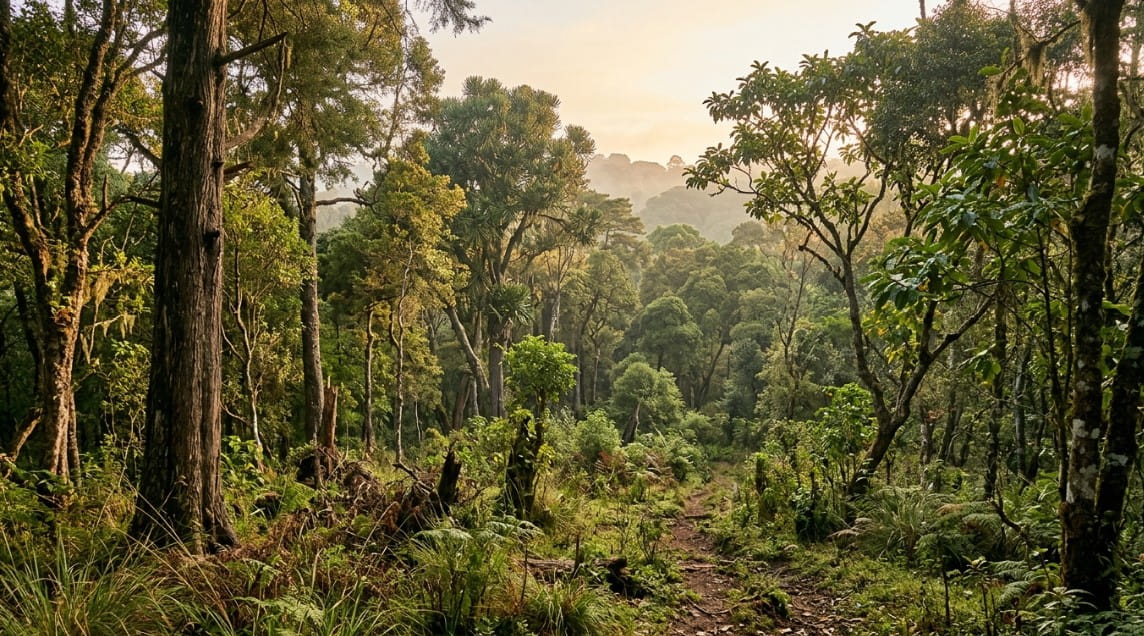
Indigenous trees are part of Kenya’s natural heritage. They occur naturally within the country’s forests, woodlands, grasslands, riverine ecosystems, coastal forests and drylands, where they have adapted to local soils, rainfall patterns, temperatures and ecological conditions.
Many indigenous trees also have practical value. They provide timber, medicine, food, shade, fodder, fuelwood and other products while supporting birds, insects, mammals and other wildlife.
Today, indigenous trees are also important in forest restoration, watershed protection, biodiversity conservation and climate resilience. Kenya Forestry Research Institute (KEFRI) has developed propagation and management technologies for several indigenous species, including Juniperus procera, Osyris lanceolata, Melia volkensii, Acacia tortilis, Ocotea usambarensis and Prunus africana.
1. What Are Indigenous Trees?
Indigenous trees are tree species that occur naturally in a particular region rather than being introduced there by people.
In Kenya, indigenous trees are found across very different environments. A tree naturally adapted to the drylands of eastern or northern Kenya may be very different from one naturally found in the wet montane forests of the central highlands.
The term indigenous therefore refers mainly to a species’ natural distribution. It does not automatically mean that every indigenous tree is rare, protected or suitable for planting everywhere in Kenya.
This distinction matters when choosing trees for farms, restoration projects, school compounds, urban areas or commercial forestry.
2. Examples of Indigenous Trees in Kenya
Kenya has a large variety of native tree species. Some are widespread, while others have much narrower ecological ranges.
Examples include:
- Acacia tortilis – umbrella thorn
- Acacia xanthophloea – fever tree
- Albizia gummifera – peacock flower
- Cordia africana – East African cordia
- Croton megalocarpus – croton
- Juniperus procera – East African cedar
- Melia volkensii – mukau
- Milicia excelsa – mvule
- Olea capensis – East African olive
- Podocarpus falcatus – East African yellowwood
- Prunus africana – African cherry
- Terminalia brownii – brown terminalia
- Vitex keniensis – Meru oak
- Warburgia ugandensis – East African greenheart
KEFRI’s tree information resources cover many of these and other indigenous species, including Albizia gummifera, Cordia africana, Croton megalocarpus, Juniperus procera, Markhamia lutea, Milicia excelsa, Prunus africana and Vitex keniensis.
3. Indigenous Trees by Ecological Region
There is no single list of indigenous trees that is equally suitable throughout Kenya.
Species selection should follow the ecological conditions of the planting site.
3.1 Indigenous Trees of the Highlands
The highlands support several important indigenous forest species.
Examples include:
- Juniperus procera
- Olea capensis
- Croton megalocarpus
- Albizia gummifera
- Podocarpus falcatus
- Prunus africana
- Warburgia ugandensis
Kenya’s Afro-montane forests occur in areas such as Mount Kenya, the Aberdares, the Mau Forest Complex, the Cherangani Hills and Mount Elgon. These forests contain mixed indigenous natural forests as well as bamboo-dominated areas.
3.2 Indigenous Trees of Western Kenya
Western Kenya has relatively wet conditions that support species associated with rainforest and moist forest ecosystems.
Examples include:
- Milicia excelsa
- Albizia gummifera
- Croton megalocarpus
- Cordia africana
- Markhamia lutea
Kakamega Forest is an important example of Kenya’s western forest ecosystems. Restoration activities there include planting indigenous tree species to improve forest regeneration and ecological integrity.
3.3 Indigenous Trees of Dryland Kenya
Dryland areas require species that can cope with limited and unreliable rainfall.
Important indigenous species include:
- Melia volkensii
- Acacia tortilis
- Terminalia brownii
- Acacia seyal
- Balanites aegyptiaca
- Sclerocarya birrea
Melia volkensii, commonly known as mukau, is particularly important in the drylands of eastern Kenya. KEFRI identifies it as one of the country’s important indigenous dryland species and has undertaken breeding and improvement work to support its commercial production.
3.4 Indigenous Trees of Riverine Areas
Riverine environments have their own conditions and should not be treated like ordinary farmland or dry woodland.
Species associated with Kenyan riverine vegetation include Acacia xanthophloea, Acacia nilotica, Populus ilicifolia, Garcinia livingstonei and other species adapted to wetter soils.
Riparian planting can also involve species such as Syzygium and Albizia gummifera, together with suitable bamboo species.
3.5 Indigenous Trees of the Coastal Region
Kenya’s coastal forests contain plant communities that differ from those of the highlands and dry interior.
Coastal indigenous trees can be important for:
- Biodiversity
- Traditional medicine
- Food
- Timber
- Shade
- Soil protection
- Cultural heritage
Some coastal forests also contain rare and endemic species that require special conservation attention.
4. Why Are Indigenous Trees Important?
Indigenous trees perform ecological functions that go beyond producing wood.
4.1 They Support Biodiversity
Native trees provide habitat and food for wildlife that has evolved alongside them.
Their flowers, fruits, leaves, bark, cavities and branches can support birds, insects, mammals, fungi and other organisms.
A diverse indigenous forest therefore supports much more than the trees themselves.
4.2 They Protect Soil
Tree roots help hold soil together and reduce erosion.
Leaves and other organic material also contribute to soil formation and nutrient cycling. In areas exposed to heavy rainfall, suitable trees can help reduce the amount of soil washed away.
4.3 They Support Water Catchments
Indigenous trees are important components of many forest ecosystems that regulate water movement through landscapes.
Restoring degraded forest and catchment areas with suitable native species can help rebuild ecological functions. Recent restoration work in Kenya has included planting indigenous trees around degraded forest areas and important water catchments.
4.4 They Support Pollinators and Other Wildlife
Flowering indigenous trees can provide nectar and pollen for insects.
Their fruits and seeds can also provide food for birds and mammals. The resulting relationships help maintain wider ecosystem processes.
4.5 They Contribute to Climate Resilience
Trees store carbon in their trunks, branches, roots and surrounding soils.
However, climate benefits depend on whether trees survive and grow well. Choosing species that match local conditions is therefore more useful than simply planting large numbers of unsuitable trees.
5. Traditional Uses of Indigenous Trees
Kenyan communities have developed extensive knowledge of native trees over generations.
The uses of individual species vary between communities and regions, but indigenous trees have traditionally supplied:
- Medicine
- Food
- Fuelwood
- Fodder
- Building materials
- Tools
- Poles
- Timber
- Household products
- Shade
- Cultural and ceremonial materials
Some species are particularly important in traditional medicine. Others have edible fruits, useful bark, seeds or leaves.
Traditional use, however, should not automatically be treated as proof that a plant-based remedy is medically effective. Traditional knowledge and scientific evidence are different forms of knowledge and should be presented separately.
6. Indigenous Trees and Timber Production
Some indigenous trees produce valuable timber.
Examples include Milicia excelsa, Vitex keniensis, Juniperus procera, Podocarpus falcatus and other high-value species.
Their timber can be used for furniture, construction, joinery and other wood products.
However, many valuable indigenous timber trees grow more slowly than some plantation species. Their management therefore requires longer-term planning.
This is one reason KEFRI has invested in research on propagation, tree improvement and domestication of selected indigenous species.
7. Indigenous Trees for Agroforestry
Indigenous trees can also be grown outside natural forests.
Farmers may integrate suitable species into:
- Crop fields
- Boundary planting
- Woodlots
- Pasture systems
- Homesteads
- Riparian buffers
- Silvopastoral systems
The choice should depend on the species, farm conditions and intended purpose.
For example, Melia volkensii has been developed for on-farm production in Kenya’s drylands. KEFRI has also worked on the domestication and improvement of other high-value tree species for agroforestry.
8. How to Choose an Indigenous Tree for Planting
Planting an indigenous tree does not mean choosing any native species and putting it anywhere.
The first question should be whether the species matches the site.
Consider:
8.1 Rainfall
Check the typical rainfall of the area.
A species adapted to a wet forest environment may struggle in a dry area unless it receives suitable water and management.
8.2 Soil
Consider soil depth, drainage, fertility, texture and moisture.
Some species tolerate poor or dry soils better than others.
8.3 Altitude
Altitude influences temperature, rainfall and growing conditions.
Species selection should therefore consider the elevation of the planting site.
8.4 Purpose
Decide what the tree is expected to provide.
The objective could be:
- Forest restoration
- Timber
- Shade
- Fodder
- Fruit
- Soil protection
- Biodiversity
- Fuelwood
- Agroforestry
- Landscaping
A restoration project and a commercial timber farm may require completely different species.
8.5 Space
Some indigenous trees eventually become very large.
Allow enough room for the mature tree, its roots and its crown.
Do not plant a large forest tree directly beside buildings, power lines or structures simply because the seedling is small.
9. Species-Site Matching Matters
One of the most important principles in tree growing is species-site matching.
This means selecting a tree species that is suited to the ecological and physical conditions of the planting site.
KEFRI has developed a species-site matching platform to support science-based tree growing in Kenya. The system is designed to provide information for agroforestry, commercial forestry and landscape restoration.
This approach is particularly important when planting indigenous trees because native status alone does not guarantee good performance at every location.
A tree can be indigenous to Kenya and still be poorly suited to a particular county, soil type or elevation.
10. How to Plant Indigenous Trees
The basic planting process depends on the species and site, but good preparation improves establishment.
10.1 Obtain Quality Seedlings
Use healthy seedlings from a reliable nursery or source.
Where possible, obtain planting material that has been selected for the ecological zone and intended purpose.
KEFRI has established seed stands, seed orchards and propagation protocols for a range of indigenous and other priority tree species.
10.2 Prepare the Site
Clear competing vegetation where necessary without causing unnecessary soil disturbance.
Dig planting holes according to the requirements of the species and site.
For restoration projects, site preparation may also involve erosion control, removal of invasive plants and protection from grazing.
10.3 Plant at the Right Time
In rain-fed areas, planting should normally be timed to make use of reliable rainfall.
The exact planting season differs between regions.
A seedling planted at the beginning of suitable rains has a better chance of establishing than one planted when the soil is already drying.
10.4 Protect Young Trees
Young indigenous trees can be damaged by livestock, wildlife, weeds, drought and human disturbance.
Protection may include:
- Tree guards
- Fencing
- Mulching
- Weed control
- Watering where necessary
- Fire protection
- Livestock control
10.5 Monitor Survival
Planting is only the beginning.
Count surviving trees and replace failed seedlings where appropriate. Kenya’s tree-growing monitoring systems increasingly include survival and mortality tracking rather than focusing only on the number of seedlings planted.
11. Indigenous Trees in Forest Restoration
Forest restoration is one of the strongest reasons for using indigenous species.
When a degraded natural forest is being restored, the objective should generally be to rebuild an ecosystem rather than simply create a stand of trees.
That means considering:
- Native species composition
- Natural regeneration
- Soil condition
- Invasive species
- Wildlife
- Water
- Fire
- Local communities
- Long-term protection
Recent restoration work in Kakamega has included removing invasive plants, preparing degraded sites and planting indigenous species to support natural forest recovery.
12. Indigenous Trees and Conservation
Some indigenous trees face pressure from habitat loss, overharvesting, illegal logging, land-use change, fire and other threats.
Conservation therefore needs to happen both inside natural forests and, where appropriate, outside them.
Useful approaches include:
- Protecting natural forests
- Supporting natural regeneration
- Establishing restoration sites
- Conserving seed sources
- Raising seedlings
- Planting suitable indigenous species on farms
- Protecting rare species
- Controlling invasive plants
- Supporting community conservation
- Maintaining traditional ecological knowledge
KEFRI research has included propagation protocols for difficult-to-propagate indigenous species and work on conservation of threatened trees in culturally important landscapes.
13. Indigenous Trees and Community Conservation
Local communities are important partners in conserving indigenous trees.
This is particularly clear in areas where forests have cultural, livelihood or historical importance.
Kenya’s coastal Kaya forests provide an example where biodiversity conservation is closely connected to cultural heritage and traditional governance. Conservation programmes have focused on threatened endemic trees, restoration and the role of Kaya elders in protecting these landscapes.
Community knowledge can also help identify useful species, seed sources, traditional uses and changes in local tree populations.
14. Are Indigenous Trees Better Than Exotic Trees?
Not always.
The better question is whether the tree is appropriate for the intended purpose and site.
Indigenous trees can be particularly valuable for biodiversity conservation, ecological restoration and protection of native ecosystems.
Some exotic species, however, are important in commercial forestry and farm forestry because they can provide timber, poles, fuelwood or other products efficiently under suitable conditions.
The choice should therefore consider the objective, ecological risks, site conditions and management requirements.
For natural forest restoration, the priority is generally to use appropriate native species rather than replacing a natural ecosystem with a plantation of unrelated species.
15. Common Mistakes When Planting Indigenous Trees
Several mistakes can reduce the survival or usefulness of indigenous trees.
Planting the wrong species
A tree may be native to Kenya but poorly adapted to the specific site.
Planting without a clear purpose
A restoration tree, timber tree and shade tree do not necessarily require the same species.
Ignoring mature size
A small seedling can become a large tree.
Poor-quality seedlings
Weak or unhealthy planting material can result in poor survival and slow growth.
Neglecting young trees
Indigenous trees still need protection and management during establishment.
Counting seedlings instead of surviving trees
A large planting exercise means little if most seedlings die.
Removing natural regeneration unnecessarily
In some restoration areas, naturally regenerating trees may already be providing the best locally adapted planting material.
16. Selected Indigenous Trees to Explore
Forestry.co.ke will cover individual indigenous species in greater detail, including their identification features, distribution, ecological roles, uses, propagation and planting considerations.
Some important species include:
- Croton megalocarpus
- Grevillea robusta
- Juniperus procera
- Melia volkensii
- Milicia excelsa
- Olea capensis
- Podocarpus falcatus
- Prunus africana
- Terminalia brownii
- Vitex keniensis
- Warburgia ugandensis
Each species has different ecological requirements. A detailed species guide is therefore more useful than treating all indigenous trees as one group.
17. The Future of Indigenous Trees in Kenya
Kenya’s indigenous trees have a role in both conservation and productive landscapes.
Research institutions are already working on propagation, improved planting material, tree domestication, restoration and management of priority indigenous species. KEFRI’s work includes propagation technologies for species such as mukau, cedar, sandalwood, indigenous bamboo and Acacia tortilis.
The growing focus on landscape restoration also creates opportunities to use indigenous species in farms, degraded forests, watersheds, riparian areas and community conservation projects.
The priority should not simply be to plant more trees. It should be to plant the right trees in the right places and keep them alive long enough to provide ecological and economic value.
18. Frequently Asked Questions
What are indigenous trees?
Indigenous trees are tree species that occur naturally within Kenya or its ecological regions. They include species found in montane forests, western forests, drylands, riverine ecosystems and coastal forests.
What is the most common indigenous tree in Kenya?
There is no single indigenous tree that can accurately be described as the most common across the whole country. Species abundance varies greatly between ecological zones.
Which indigenous trees are good for planting in Kenya?
The best species depends on the location and purpose. Species such as Melia volkensii are important in dryland agroforestry, while other indigenous species are better suited to highland, western, riparian or coastal environments.
Are indigenous trees good for timber?
Yes. Several indigenous Kenyan trees produce valuable timber, including species such as Milicia excelsa, Vitex keniensis, Juniperus procera and Podocarpus falcatus.
Can indigenous trees be planted on farms?
Yes. Suitable indigenous species can be integrated into farms through agroforestry, boundary planting, woodlots, pasture systems and other approaches.
Why should indigenous trees be conserved?
They support biodiversity, ecological processes, soil and water conservation, genetic diversity and cultural heritage. Some also provide important products and livelihoods.
How do I know which indigenous tree to plant?
Start with the planting site’s rainfall, altitude, soil, available space and intended purpose. Species-site matching is more reliable than choosing a tree simply because it is indigenous.
Summary
Indigenous trees are an important part of Kenya’s forests, farms, drylands, rivers and cultural landscapes.
Their value goes beyond timber. They support biodiversity, protect soils, contribute to water catchment functions, provide useful products and preserve genetic and cultural heritage.
The best approach to planting indigenous trees is therefore not simply to choose a native species. Choose a species that belongs in the landscape, matches the site and serves a clear purpose.
Leave a Reply