

Quick Facts
| Attribute | Details |
|---|---|
| Common Name | Umbrella Thorn, Umbrella Thorn Acacia |
| Scientific Name | Vachellia tortilis (Forssk.) Galasso & Banfi |
| Synonym | Acacia tortilis (Forssk.) Hayne |
| Family | Fabaceae |
| Native / Exotic | Indigenous in Kenya |
| Tree Type | Evergreen or semi-evergreen thorny tree |
| Mature Height | 4 to 21 metres |
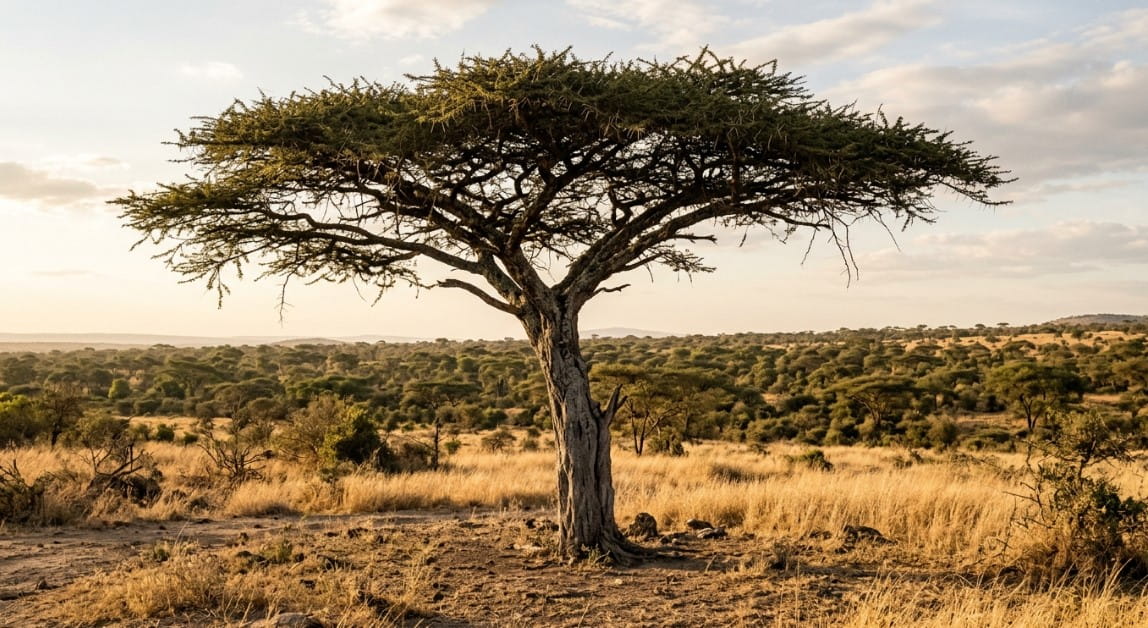
| Crown Shape | Broad, flat or spreading, often umbrella-shaped |
| Growth Rate | Fast under suitable conditions |
| Lifespan | Several decades; exact lifespan varies with site conditions |
| Altitude Range | 0 to about 1,650 metres in Kenya |
| Annual Rainfall | About 150 to 900 mm in Kenyan suitability data |
| Temperature | About 23°C to 31°C in Kenyan suitability data |
| Preferred Soils | Well-drained sandy, sandy-loam, rocky and alkaline soils |
| Drought Tolerance | Very high |
| Conservation Status | Least Concern globally |
| Best Uses | Fodder, fuelwood, charcoal, timber, fencing, shade, bee forage, soil conservation and dryland restoration |
The accepted botanical name is now Vachellia tortilis, although Acacia tortilis remains extremely common in Kenyan forestry literature and general use. Kew recognises Vachellia tortilis as the accepted name and Acacia tortilis as a synonym.
Species at a Glance
| Characteristic | Rating |
|---|---|
| Growth Rate | ⭐⭐⭐⭐☆ |
| Timber Value | ⭐⭐⭐⭐☆ |
| Drought Tolerance | ⭐⭐⭐⭐⭐ |
| Wildlife Value | ⭐⭐⭐⭐⭐ |
| Carbon Storage | ⭐⭐⭐⭐☆ |
| Agroforestry Suitability | ⭐⭐⭐⭐☆ |
| Rangeland Suitability | ⭐⭐⭐⭐⭐ |
| Soil Improvement | ⭐⭐⭐⭐☆ |
| Urban Suitability | ⭐⭐☆☆☆ |
| Maintenance | Low to Medium |
| Beginner Friendly | Yes, with site protection |
The ratings here are practical our own editorial ratings, not formal scientific scores. The species is particularly strong for dryland rangelands, fodder, ecological restoration and soil protection. Kenyan tree-selection data also lists it for scattered cropland, homesteads, live fences, woodlots, river and lake shores, and soil-conservation structures.
1. Introduction
Acacia tortilis, now accepted botanically as Vachellia tortilis, is one of the most recognisable indigenous trees of Kenya’s drylands. Its broad, spreading crown gives mature trees the characteristic umbrella shape associated with East African savannas.
The species is highly adapted to heat, drought and prolonged dry periods. In Kenya, it is particularly important in arid and semi-arid landscapes where trees must survive conditions that are difficult for many other species. Research on Kenyan populations describes V. tortilis as highly drought tolerant and capable of growing across a wide range of rainfall conditions. (SpringerLink)
It is also a multipurpose tree. Livestock and wildlife browse its foliage and pods, while communities use its wood for fuel, charcoal, poles, fencing and other purposes. Its flowers provide resources for pollinating insects, while its canopy offers shade and habitat for birds and other wildlife.
2. What Is Acacia tortilis?
Acacia tortilis is a woody member of the Fabaceae family. It is an indigenous species of Kenya and one of the trees associated with African dryland ecosystems.
The species is highly variable in form. Depending on local conditions, it may occur as a relatively small tree or develop into a much larger specimen with a wide, spreading crown.
Modern botanical classification places the species under the genus Vachellia. The currently accepted name is Vachellia tortilis, while Acacia tortilis remains an important synonym and is still widely used in forestry, agriculture and general references.
For Kenyan readers, both names are therefore worth knowing.
3. How to Identify Acacia tortilis
The umbrella-shaped crown is usually the first feature people notice.
However, reliable identification should use several characteristics rather than crown shape alone.
3.1 Crown
The crown is generally broad and spreading.
Older trees can develop a distinctly flat-topped or umbrella-like form. The crown may become especially wide compared with the height of the trunk.
The shape can vary depending on browsing, drought, competition and growing conditions.
3.2 Bark
The bark is grey to dark grey or almost black on older trees.
It becomes increasingly cracked and fissured as the tree matures.
3.3 Spines
The branches carry spines that can occur in different forms.
Some are short and hooked, while others are longer and relatively straight. This combination is useful when distinguishing A. tortilis from some other thorny dryland trees.
The spines also make the tree less suitable for planting close to paths, buildings or areas where people and livestock move frequently.
3.4 Leaves
The leaves are finely divided and bipinnate.
The individual leaflets are very small, giving the foliage a delicate appearance despite the tree’s tough growth habit.
The fine leaves are one reason the tree can be mistaken for other African acacias and related species.
3.5 Flowers
The flowers occur in small rounded heads.
They are generally cream or whitish rather than large and showy.
Flowering characteristics can vary with location and seasonal conditions.
3.6 Pods
The fruit is one of the most useful identification features.
The pods are strongly curved, twisted or spirally coiled. This distinctive form is responsible for the common name curly-pod acacia.
The pods also have practical value because they are eaten by livestock and other animals.
4. Where Does Acacia tortilis Grow in Kenya?
Acacia tortilis is strongly associated with Kenya’s dryland regions.
It occurs in arid and semi-arid landscapes, including dry grasslands, bushlands, scrub and some riverine areas.
Kenyan forestry research has documented the species in areas ranging from dry northern landscapes to semi-arid regions and riverine environments. It can occur on different soil types, including sandy, silty and heavier soils.
Its ability to tolerate harsh conditions makes it an important species for dryland forestry.
The species is also found across a broad altitudinal range in Kenya, although its strongest association is with lowland dry environments.
5. Acacia tortilis and Dryland Ecology
Drylands are not empty landscapes. They contain complex ecosystems where trees, grasses, shrubs, livestock and wildlife interact.
Acacia tortilis is an important component of many of these systems.
Its canopy creates shade that can alter the temperature and moisture conditions beneath the tree. The tree also contributes organic material to the soil through falling leaves, flowers, twigs and pods.
Its presence can therefore influence the immediate environment around it.
5.1 Soil Improvement
Like other legumes, Acacia tortilis forms relationships with nitrogen-fixing bacteria associated with its roots.
This allows the tree to contribute to nitrogen cycling within the ecosystem.
The effect should not be interpreted as meaning that every tree will automatically increase farm soil fertility. Soil improvement depends on the wider ecological system, management and decomposition of plant material.
5.2 Soil Protection
The root system helps anchor soil and the canopy reduces the direct impact of rainfall on exposed ground.
In dryland restoration, retaining suitable native trees alongside grasses and other vegetation can help maintain ground cover and reduce degradation.
5.3 Wildlife Habitat
The tree provides shelter, nesting sites and food resources for a range of organisms.
Its flowers can support insects, while its foliage and pods are used by herbivores and livestock.
The tree’s structure also adds vertical diversity to otherwise open dryland vegetation.
6. Uses of Acacia tortilis in Kenya
One reason Acacia tortilis is so important is its many uses.
6.1 Fodder
The leaves and pods are valuable sources of browse.
They can be particularly useful during dry seasons when grasses and other pasture resources become limited.
Sheep, goats and other livestock can feed on parts of the tree, although the amount and method of use should depend on local livestock management practices.
6.2 Fuelwood
The wood is dense and useful as fuel.
It has traditionally been used as firewood in dryland communities.
The species is also important for charcoal production, although harvesting pressure needs to be managed to prevent degradation of natural stands.
6.3 Charcoal
Acacia tortilis is considered an important charcoal species in Kenya’s dry areas.
Its dense wood produces useful charcoal, which explains why the species can face pressure in areas where charcoal production is intensive.
Sustainable management is therefore essential. A tree that is valuable for energy can quickly become depleted if harvesting exceeds regeneration.
6.4 Timber
The wood can be used for various purposes, including posts and other construction-related applications.
Its wood properties also give it value for household and rural uses.
It is not, however, normally treated in the same commercial plantation category as Kenya’s major plantation timber species.
6.5 Posts and Fencing
The strong wood and thorny nature of the tree make it useful for fencing materials.
Branches can also be used in traditional livestock and farm structures.
6.6 Shade
The broad crown provides valuable shade in hot dry environments.
Trees retained in grazing landscapes can create resting areas for livestock and contribute to more varied microclimates.
6.7 Bee Forage
The flowers provide forage for bees and other insects.
This makes the tree relevant to beekeeping and wider dryland livelihood systems.
7. Acacia tortilis for Livestock Production
The relationship between Acacia tortilis and livestock is especially important in Kenya’s ASALs.
Dryland livestock systems depend on a mixture of grasses, shrubs and trees rather than grass alone.
During prolonged dry periods, trees such as Acacia tortilis can provide browse when herbaceous vegetation has declined.
Its pods can also become an important feed resource.
This makes conservation of mature dryland trees relevant not only to biodiversity but also to pastoral and agro-pastoral livelihoods.
8. Propagation of Acacia tortilis
Acacia tortilis is mainly propagated from seed.
However, successful establishment begins with good seed collection and preparation.
Seeds should be obtained from healthy, well-adapted parent trees where possible. The source of seed matters because trees growing under different conditions may differ in performance.
KEFRI has conducted research on improving Acacia tortilis seed germination and has developed propagation and management technologies for the species.
8.1 Seed Dormancy
Like many dryland legumes, the seeds have a hard seed coat.
This can restrict water absorption and delay germination.
Seed pre-treatment can therefore improve germination.
Research by KEFRI has specifically examined pre-treatment methods for improving the germination of Acacia tortilis seeds.
8.2 Nursery Production
Healthy seed should be sown in a suitable nursery medium and protected from excessive moisture, pests and physical damage.
Seedlings should be managed until they have developed a healthy root system and are strong enough for field planting.
Avoid keeping seedlings in nursery containers for too long because root development can become restricted.
9. Planting Acacia tortilis in Kenya
Acacia tortilis is most appropriate where its ecological requirements match the site.
It is particularly suitable for dryland and semi-arid environments.
9.1 Choose the Site Carefully
Before planting, consider:
- Rainfall
- Soil type
- Drainage
- Elevation
- Grazing pressure
- Available space
- Intended use
- Risk of fire
- Access to water during establishment
The species can tolerate harsh conditions, but young seedlings are still vulnerable to drought and competition.
9.2 Prepare the Planting Hole
Prepare the planting site before the rains where possible.
The exact hole size and spacing should depend on the planting objective and local soil conditions.
Trees planted for restoration may require different spacing from trees planted in a farm woodlot or agroforestry system.
9.3 Plant With the Rains
In rain-fed drylands, planting at the beginning of reliable rains gives seedlings the best opportunity to establish roots before the next dry period.
Planting timing should follow local rainfall patterns rather than a single national planting date.
9.4 Protect the Seedlings
Young Acacia tortilis trees can be damaged by browsing livestock.
Protection may be necessary during establishment, particularly in heavily grazed areas.
Weed competition should also be controlled around young trees where it threatens establishment.
10. Acacia tortilis in Agroforestry
The species has potential in dryland agroforestry, but its use requires careful planning.
Its broad crown can compete with crops for light, water and space.
Its thorns can also create difficulties around people, livestock and farm operations.
For these reasons, planting patterns should be based on the intended purpose and the needs of other crops or pasture.
In some situations, retaining naturally occurring mature trees may be more appropriate than establishing dense plantations.
11. Acacia tortilis in Rangeland Management
Dryland rangelands benefit from a mixture of trees, shrubs and grasses.
Removing all trees can reduce habitat diversity and remove important sources of fodder and shade.
At the same time, excessive tree and shrub cover can alter grass production and grazing conditions.
Good rangeland management therefore focuses on maintaining a functional balance between woody vegetation, grasses, livestock and wildlife.
KEFRI has documented Acacia tortilis as an important indigenous species in rangeland rehabilitation work in northern Kenya, including efforts to protect existing native vegetation while improving pasture resources.
12. Acacia tortilis and Conservation
Globally, Vachellia tortilis is assessed as Least Concern on the IUCN Red List.
That does not mean every local population is secure.
Dryland trees can still face pressure from charcoal production, fuelwood harvesting, land degradation, overgrazing, agricultural expansion and other forms of land-use change.
Local conservation is therefore important even when a species is not globally threatened.
Protecting mature trees, allowing natural regeneration and managing harvesting can help maintain healthy populations.
13. Natural Regeneration
Natural regeneration can be an important way of maintaining Acacia tortilis populations.
Trees produce seeds that can be dispersed by animals and other processes.
Where seedlings are naturally establishing, land managers should consider whether these young trees can be protected rather than clearing them and replacing them with nursery seedlings.
Natural regeneration has one major advantage. The surviving trees are already establishing under local environmental conditions.
However, regeneration can be limited by grazing, seed predation, drought, fire and other pressures.
14. Acacia tortilis and Climate Resilience
The species’ tolerance of dry conditions makes it relevant to climate adaptation in Kenya’s ASALs.
KEFRI is also undertaking tree breeding work involving Acacia tortilis, including efforts aimed at improving productivity and drought tolerance.
This research is important because climate change is expected to increase pressure on water resources and dryland ecosystems.
Drought-tolerant indigenous species can form part of broader adaptation and restoration strategies when they are planted in environments where they naturally belong.
15. Common Problems When Growing Acacia tortilis
Excessive browsing
Livestock can damage young seedlings before they become established.
Poor seed germination
Untreated seed may germinate unevenly because of its hard seed coat.
Planting in unsuitable areas
Being drought tolerant does not mean the species will perform well everywhere.
Overcrowding
The mature crown can spread widely. Dense planting can create unnecessary competition for water and space.
Planting too close to buildings
The thorns and spreading branches make the species unsuitable for many confined urban spaces.
Unsustainable harvesting
Heavy cutting for charcoal and fuelwood can reduce mature tree populations and weaken dryland ecosystems.
16. How Long Does Acacia tortilis Take to Grow?
Growth rate varies considerably with rainfall, soil, browsing pressure and management.
A tree growing with adequate moisture and protection can establish much faster than one exposed to severe drought and repeated browsing.
KEFRI nursery records show that Acacia tortilis can establish and grow successfully under nursery conditions, but nursery growth should not be confused with growth rates under harsh field conditions.
For dryland forestry, survival and long-term establishment are often more important measures than simply seeking rapid early height growth.
17. Acacia tortilis Compared With Other Dryland Trees
Kenya has several important indigenous trees adapted to dry environments.
Acacia tortilis differs from species such as Melia volkensii, Balanites aegyptiaca, Acacia senegal and Terminalia brownii in crown form, leaves, pods, uses, growth requirements and ecological distribution.
The umbrella-shaped crown and strongly twisted pods are particularly useful identification features.
Species selection should always be based on the specific site and intended purpose rather than assuming that one dryland tree is suitable everywhere.
18. Why Acacia tortilis Matters in Kenya
Acacia tortilis brings together several important aspects of Kenyan dryland forestry.
It is indigenous. It provides livestock feed. It supplies fuelwood and charcoal. It contributes to soil and ecosystem functions. It provides shade and habitat. It can also support restoration and climate adaptation.
Its value therefore extends beyond the individual tree.
A healthy population of Acacia tortilis can be part of a functioning dryland landscape where trees, grasses, livestock, wildlife and communities interact.
19. Frequently Asked Questions
What is Acacia tortilis called in Kenya?
It is commonly known as the umbrella thorn or umbrella thorn acacia. It also has many local names used by different Kenyan communities.
Is Acacia tortilis indigenous to Kenya?
Yes. Acacia tortilis is an indigenous tree in Kenya and is widespread in many arid and semi-arid parts of the country.
What is the scientific name of the umbrella thorn?
The name commonly used in Kenya is Acacia tortilis (Forssk.) Hayne. The currently accepted botanical name is Vachellia tortilis (Forssk.) Galasso & Banfi.
Where does Acacia tortilis grow in Kenya?
It is mainly found in arid and semi-arid areas, including dry grasslands, bushlands, scrub and some riverine environments.
What is Acacia tortilis used for?
Major uses include fodder, fuelwood, charcoal, fencing materials, shade, timber and other rural products.
Can Acacia tortilis be planted on farms?
Yes. It can be used in suitable dryland agroforestry and farm forestry systems, but its spreading crown, thorns and water competition should be considered when choosing planting arrangements.
Do goats and sheep eat Acacia tortilis?
Yes. Its leaves and pods are used as browse and fodder, particularly during dry periods.
Is Acacia tortilis good for charcoal?
Its dense wood makes it a useful charcoal species. However, harvesting should be managed sustainably to avoid depletion of natural dryland stands.
Is Acacia tortilis endangered?
Globally, the species is currently classified as Least Concern. Local populations can still be affected by land degradation, overharvesting and other pressures.
How do you propagate Acacia tortilis?
The species is mainly propagated from seed. Because the seeds have a hard coat, suitable pre-treatment can improve germination.
Why is Acacia tortilis called umbrella thorn?
The name comes from its characteristic broad, flattened crown combined with its prominent thorns.
Summary
Acacia tortilis is one of Kenya’s most important indigenous dryland trees.
Its umbrella-shaped crown may be its most recognizable feature, but its real importance lies in what it contributes to dryland ecosystems and communities. It provides fodder, fuelwood, charcoal, shade and other useful products while supporting soil protection, biodiversity and ecological resilience.
For farmers, pastoralists and restoration practitioners, the lesson is simple: the umbrella thorn is not just a tree that survives dry conditions. It is part of the dryland system itself.
Related Species Guides
Explore more detailed species guides on important Kenyan tree species, including:
- Cupressus lusitanica – Mexican Cypress
- Grevillea robusta – Grevillea
- Melia volkensii – Mukau
- Pinus species – Pine Trees
Leave a Reply